Table of Contents

If you’re the treasurer of a PAC or Super PAC, FEC Form 3X is your filing home base. It’s the primary report for disclosing every dollar in and every dollar out: contributions received, disbursements made, independent expenditures, loans, debts, and more. Get it right, and you’ve met your federal disclosure obligations. Get it wrong, and you’re looking at Requests for Additional Information (RFAIs), amendments, and potentially significant fines.
Consider this your practical companion to the official FEC Form 3X instructions, breaking down what each section requires, which schedules attach where, and where most treasurers run into trouble.

Who Files FEC Form 3X?
Form 3X is required for any political committee that’s not an authorized candidate committee, including:
- Separate Segregated Funds (SSFs): corporate and labor PACs
- Nonconnected committees: traditional independent PACs
- Independent Expenditure-Only Committees: Super PACs
- Hybrid PACs: committees with both contribution accounts and non-contribution (IE-only) accounts
- Party committees at the national, state, district, and local level
If your committee is authorized by a candidate, you’re filing Form 3 (House/Senate) or Form 3P (presidential). Everyone else is on 3X.
Filing Frequency: Quarterly, Monthly, or Both?
PACs have two primary options for PAC reporting requirements under the FEC:
- Quarterly filers (election years) must file by April 15, July 15, October 15, and January 31. In non-election years, the schedule shifts to a mid-year report (due July 31) and a year-end report (due January 31).
- Monthly filers must submit reports no later than 20 days after the close of each month.
Note that in 2025 (a non-election year) all PACs and party committees filed either semi-annual or monthly reports. In 2026, an election year, quarterly filers resumed the standard quarterly-plus-pre/post-election schedule.
A few things worth keeping in mind:
- Pre-election reports are required no later than the 12th day before any primary or general election in which the committee makes contributions or expenditures.
- A 30-Day Post-General Election Report is required of all committees, covering activity through the 20th day after the election.
- Committees can switch between quarterly and monthly filing, but only once per calendar year, and only by notifying the FEC in writing at the time they file their current report.
The treasurer is personally responsible for both the timeliness and the accuracy of every report. Under the FEC’s Administrative Fine Program, late or inaccurate reports can trigger civil monetary penalties up to $29,027, or even higher for repeat violations.
Electronic Filing: Who’s Required, and What It Means
Any PAC that receives contributions or makes expenditures exceeding $50,000 in a calendar year (or has reason to expect to) must file electronically. New committees cross the e-filing threshold if they hit $12,500 in the first calendar quarter, or $25,000 in the first half of the year.
Electronic reports must be received and validated by the FEC’s system by 11:59 p.m. Eastern time on the filing deadline. “Submitted” is not the same as “validated.” If your file fails validation, it hasn’t been filed.
The Structure of Form 3X: Pages Before Schedules
Before we get to the schedules, it’s worth understanding how Form 3X is organized at the summary level. There are two layers: the Summary Page and the Detailed Summary Page. The schedules feed up into the Detailed Summary, which feeds up into the Summary. Think of it as working bottom-up.
Page 1: Report Identification
This is where the committee identifies itself and the nature of the filing:
- Line 1: Committee name and mailing address
- Line 2: FEC Identification Number (assigned when the committee registered on Form 1)
- Line 3: Mark whether this is a new (original) report or an amendment to a previously filed report
- Line 4: Report type: quarterly, monthly, pre-election, post-general, year-end, or termination
- Line 5: Coverage period: the date range this report covers, beginning where the last report ended
Getting Lines 3–5 wrong is one of the most common clerical errors. Filing as “new” when it should be an amendment, or overlapping your coverage dates with a prior report, can generate immediate FEC flags.
Page 2: Summary Page
This page gives the FEC (and the public) a high-level financial picture of the committee:
- Line 6: Cash on hand at the start of the calendar year
- Lines 7–10: Prior period totals carried forward
- Line 11: Total contributions received this period and calendar year-to-date
- Lines 12–19: Total receipts, itemized by category
- Lines 21–31: Total disbursements, itemized by category
- Lines 33–38: Closing cash-on-hand calculations
Two columns run through the entire Summary Page: Column A (this reporting period) and Column B (calendar year-to-date). Both must be accurate. Column B errors are common when committees amend prior reports without updating year-to-date totals downstream.
Schedule-by-Schedule Breakdown
This is where the real work happens. Each schedule supports a category of receipts or disbursements on the Detailed Summary Page. Use a separate schedule for each line number it supports.
Schedule A: Itemized Receipts
Schedule A itemizes individual contributions and other receipts. The $200 aggregate threshold is the key rule: any contributor who gives more than $200 in aggregate during the calendar year must be itemized with their full name, mailing address, occupation, and employer. Contributions at or below that threshold are reported as unitemized totals on Line 11(b).
For PAC treasurers, “best efforts” is the operative legal standard. If a contribution arrives without complete donor information, you must make a good-faith attempt to obtain it. Document that effort. It matters if the FEC asks.
Schedule B: Itemized Disbursements
Schedule B covers all payments made by the committee. Any single disbursement to a payee that aggregates more than $200 during the calendar year must be itemized with the payee’s name, address, date, amount, and (this is critical) the purpose of the disbursement. Vague purpose descriptions such as “operating expenses” or “consulting” are a persistent RFAI trigger. Be specific: “monthly office rent,” “digital advertising, October 2026,” “legal compliance review.”
Schedule C: Loans
Use Schedule C to disclose all loans received by the committee, including endorsers and guarantors. Every loan must be reported, whether or not it’s ultimately repaid. Loans from financial institutions additionally require a Schedule C-1.
Schedule D: Debts and Obligations
Schedule D covers debts and obligations owed to or by the committee that don’t yet appear as disbursements. Accrued expenses, unpaid vendor invoices, and outstanding obligations all live here. This schedule rolls forward each reporting period until the debt is settled. Committees commonly forget to continue carrying it forward, which generates FEC discrepancies.
Schedule E: Independent Expenditures
For Super PACs, this is the most scrutinized schedule on the form. Super PAC FEC Form 3X filings live and die by Schedule E. It itemizes all independent expenditures: spending to expressly advocate for the election or defeat of a federal candidate, made without coordination with the candidate’s campaign. Required fields include the payee, date, amount, purpose, the candidate supported or opposed, and the aggregate amount expended for that candidate in the calendar year.
Schedule E also drives two critical real-time reporting obligations that operate outside the regular filing cycle:
- 48-Hour Reports: When independent expenditures aggregate $10,000 or more for a given election in any calendar year (including non-election years), the committee must file within 48 hours of the expenditure being publicly disseminated.
- 24-Hour Reports: During the period after the 20th day but more than 24 hours before an election, independent expenditures that aggregate $1,000 or more per election must be reported within 24 hours.
Each time subsequent expenditures for the same race hit an additional $10,000 (48-hour) or $1,000 (24-hour) threshold, a new report is required. These are filed on Schedule E and also reported again on the committee’s next regularly scheduled Form 3X.
Missing a 24- or 48-hour notice carries its own fine calculation: $183 per untimely notice plus 10% of the dollar amount of the contributions not timely reported.
Schedule F: Coordinated Party Expenditures
Schedule F is used exclusively by party committees to disclose coordinated expenditures made on behalf of federal candidates. Most PAC treasurers won’t use this one, but it’s worth knowing it exists.
Schedules H1–H6: Allocated Federal/Nonfederal Activity
The H schedules are the most complex on Form 3X, and the most likely to generate RFAIs for PACs that have both federal and nonfederal activity. They cover:
- H1: The allocation method used for shared administrative expenses
- H2: Allocation ratios for specific fundraising events and candidate support
- H3: Transfers from nonfederal accounts to cover allocable expenses
- H4: Actual disbursements for allocated federal/nonfederal activity
- H5 and H6: Levin fund activity (state and local party committees only)
For PACs, H1, H2, and H4 are the most commonly required. If your PAC conducts any activity that involves both federal and nonfederal components (shared overhead, fundraising events that benefit both), you need an allocation methodology established before the reporting period begins, not after.
Schedules L, L-A, L-B: Levin Funds
These schedules are specific to state, district, and local party committees that receive and spend Levin funds for allocable federal election activity. They’re rarely filed by traditional PACs.
The Treasurer’s Legal Exposure
This bears emphasis: the treasurer signs Form 3X under penalty of perjury. By signing, the treasurer certifies that the report is true, correct, and complete. Personal liability for PAC compliance failures is real.
That’s not meant to be alarming. It’s the reality of the role, and it’s why the software you use to build and file these reports matters more than most treasurers initially appreciate.
How ISPolitical Automates Form 3X
Filing Form 3X accurately is a data management problem as much as a compliance one. Every receipt, disbursement, loan, and independent expenditure has to be categorized correctly, tracked cumulatively against the right thresholds, and carried forward between reporting periods without gaps.
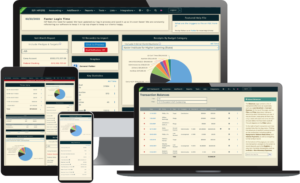
ISPolitical’s PAC management software handles that work end-to-end. Once a bank file is uploaded, the platform’s AI-assisted reconciliation matches transactions against the appropriate Form 3X lines and schedules. It monitors independent expenditure thresholds and automatically triggers alerts when 24- and 48-hour filing deadlines apply, so the treasurer knows exactly what needs to be filed and when, without having to track it manually. The relevant transactions are pre-selected, so it’s a matter of confirming and filing rather than hunting through records under deadline pressure.
For Super PACs, that threshold monitoring is especially critical. When spending crosses a 24- or 48-hour reporting trigger, ISP alerts the treasurer immediately, and because all disbursements and donor disclosures are already in the system, generating the report is straightforward. Treasurers still walk through the generation process to confirm options and finalize details, but they’re doing it with everything already in place rather than scrambling to pull records together at the last minute.
ISP also maintains the audit-ready documentation that makes responding to FEC RFAIs fast, and that reduces your personal risk exposure as the treasurer.
Want To Take Form 3X Off Your Plate?
If you’re managing PAC compliance manually or patching together spreadsheets and legacy filing tools, you already know how much time Form 3X takes, and how much risk comes with doing it that way. Get in touch with ISPolitical to see how the platform handles Form 3X filing for PACs and Super PACs, from initial setup through every reporting deadline.
Explore Cutting Edge ISP Software →